 | In these two clips from Ken McMullen's improvisational 'Ghost Dance' (1983), Jacques Derrida describes an 'unnatural' ghostly haunting whereby the dead are taken into us, but they are not internalized as they would be under more 'normal' circumstances (a psychoanalytic view of mourning) - he labels this as 'terrifying;' in the second excerpt, Derrida recounts his 1982 arrest in Czechoslavakia on trumped-up drug charges ... Derrida, who was working on an essay about Czech author Franz Kafka (ironically, regarding the 'Before the Law' section of 'The Trial'), claims Kafka's ghost seemed to 'direct' this entire scenario in a strange film-like way ... the actresses are Leonie Mellinger and the late Pascale Ogier... |
 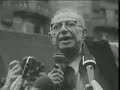 | Jean Paul Sartre, friend of Frantz Fanon and Albert Camus and philosopher who supported the independence of the Algerian people. |
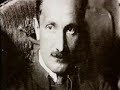 | Martin Heidegger's 1927 magnum opus 'Being and Time' ('Sein und Zeit') is regarded as a twentieth-century philosophical classic... such notions as temporality, angst, authenticity, resolve, The One, The Other, being-toward-death, everydayness, etc., became standard verbiage in later Existentialism... here, philosopher Andrew Benjamin, literary critic George Steiner, and Hannah Arendt biographer Elizabeth Young-Bruel discuss the impact of this monumental work... |
 | Continued coverage (part4) |
 | In 1971, American linguist/social activist Noam Chomsky squared off against French philosopher Michel Foucault on Dutch television ... the program was entitled 'Human Nature: Justice Vs. Power' and offered sharp contrasts between the more traditional view of 'human nature' and what would become a postmodernist perspective ... Chomsky, following a rationalist lineage going back to at least Plato, believes that there is a foundational 'nature' and that its positive aspects (love, creativity, recognizing and embracing justice) must be realized, while Foucault remains skeptical of any such notion... for him, the issue is not so much whether 'justice' or 'human nature' 'exists,' but how they have historically (and currently) function in society ... in regard to justice, he says (this is not included in the clips): "... the idea of justice in itself is an idea which in effect has been invented and put to work in different types of societies as an instrument of a certain political and economic power or as a weapon against that power..." The point of any political struggle, for Foucault, is to alter the 'power relations' in which we all find ourselves ... |
 | In 1971, American linguist/social activist Noam Chomsky squared off against French philosopher Michel Foucault on Dutch television ... the program was entitled 'Human Nature: Justice Vs. Power' and offered sharp contrasts between the more traditional view of 'human nature' and what would become a postmodernist perspective ... Chomsky, following a rationalist lineage going back to at least Plato, believes that there is a foundational 'nature' and that its positive aspects (love, creativity, recognizing and embracing justice) must be realized, while Foucault remains skeptical of any such notion... for him, the issue is not so much whether 'justice' or 'human nature' 'exists,' but how they have historically (and currently) function in society ... in regard to justice, he says (this is not included in the clips): "... the idea of justice in itself is an idea which in effect has been invented and put to work in different types of societies as an instrument of a certain political and economic power or as a weapon against that power..." The point of any political struggle, for Foucault, is to alter the 'power relations' in which we all find ourselves ... |
 | www.predicad0r.blogspot.com conceptualized Hannah Arendt the "banality of evil" administrative and bureaucratic machinery necessary to manage something trivial like taxes or direct mail and at the same time manage the movement of trains leaving full to the death camps. The "banality of evil" present in the bureaucrats who managed the same way the distribution of cards while driving millions of people for extermination. Chomsky in a similar direction wonders beyond the common perception of doom and terror against the horrors of war: what is worse a monster like Hitler or general apathy and disinterest? Source: Manofacturing consent " " The most successful documentary in Canadian history and one of the most watched in the world. It lasts about three hours, has been awarded more than twenty times, is dedicated to the political thought of Noam Chomsky and focused on his criticism of the media in democratic societies. " |
 | De rares images de l'inventeur de la phéno. transcendentale |
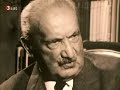 | Heidegger concludes his 1969 German television interview with Richard Wisser in the following way: "No one knows what the fate of thinking will look like. In a lecture in Paris in 1964, which I did not give myself but was presented in a French translation, I spoke under the title: "The End of Philosophy and the Task of Thinking." I thus make a *distinction* between philosophy, that is metaphysics, and thinking as I understand it. The thinking that I contrast with philosophy in this lecture—which is principally done by an attempt to clarify the essence of the Greek "aletheia" (unhiddenness) — this thinking is, compared to metaphysical thinking, much simpler than philosophy, but precisely because of its simplicity it is much more difficult to carry out. And it calls for new care with language, not the invention of new terms, as I once thought, but a return to the primordial content of our own language, which is, however, constantly in the process of dying off. A coming thinker, who will perhaps be faced with the task of really taking over this thinking that I am attempting to *prepare,* will have to obey a sentence Heinrich von Kleist once wrote, and that reads "I step back before one who is not yet here, and bow, a millennium before him, to his spirit." Tags: Heidegger Task-of-Thinking Richard-Wisser German-Television 1969 aletheia von Kleist philosophy Added: 2 months ago From: hiperf289 Views: 1,447 |
 | extrait d'un cours de Deleuze à Vincennes |


